Hunter Education Requirements by State: A Hunter’s Guide
Every fall I get the same phone call from somebody’s dad: “My kid wants to go sit with me this year, what do I need to do?” And every fall I have to ask what state they hunt in, because the answer is never the same twice. Hunter education requirements by state are a patchwork — some states require a course for anyone born after a certain year, some require it for every first-time buyer regardless of age, and a couple still let you buy an apprentice license with no course at all if you’re hunting under a licensed adult.
This isn’t red tape for the sake of red tape. Hunter education programs grew out of a real problem — hunting incident rates were genuinely bad before states started mandating certified courses in the mid-20th century. The numbers improved. A lot. But the rules that got us here are state-specific, and if you assume your home state’s rules travel with you to a new hunting lease three states over, you’re going to have a bad morning at the check station.
I learned this one the hard way, not personally, but watching a buddy’s nephew get turned away from buying a license in Ohio because his home-state Kentucky youth exemption didn’t carry over. The kid had hunted two full seasons already. Didn’t matter. Ohio wanted its own proof or a completed course, full stop. We drove forty-five minutes to find a weekend class instead of hunting that Saturday. Lesson learned: check the state you’re hunting in, not the state you’re from.
Why Hunter Education Exists in the First Place
Before mandatory hunter education became the norm, hunting-related shooting incidents were a real and frequent problem in the woods. States started requiring certification courses starting in the 1950s and 60s, and by now all 50 states and every Canadian province require some form of certification for first-time hunters. The U.S. Fish and Wildlife Service helps fund these programs through excise taxes on firearms and ammunition under the Pittman-Robertson Act, so in a roundabout way, every box of shells you buy is paying for the kid sitting through hunter ed this weekend.
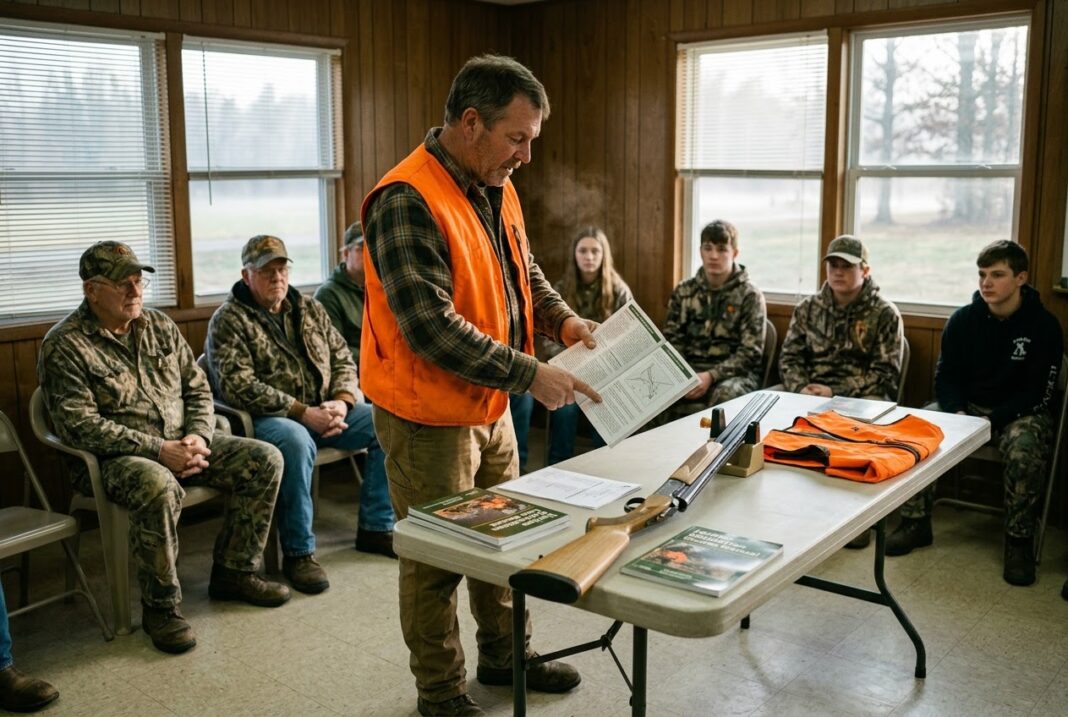
The course content is fairly standard across states: firearm safety and handling, tree stand safety, wildlife identification, hunting ethics, and often a section on landowner relations and trespass law. What varies is who has to take it, how old they have to be, and whether online-only completion counts or if a field day with live-fire exercises is mandatory.
The Basic Rule Almost Every State Follows
Here’s the baseline, and it covers the majority of states: if you were born after a specific cutoff year — commonly 1972, 1975, or January 1, 1990, depending on the state — you must complete an approved hunter education course before you can buy your first hunting license. Born before that date? Many states grandfather you in with no course required, on the assumption you grew up hunting before certification existed.
That cutoff year is not uniform, and it’s worth checking even if you think you’re obviously exempt. I’ve seen grown men in their fifties get stopped at the counter because their state’s cutoff was later than they assumed. Don’t guess. Pull up your state wildlife agency’s license page before you drive to the sporting goods store.
States With No Age Exemption — Everyone Takes the Course
A smaller number of states require hunter education for all first-time license buyers, period, regardless of birth year. If you’ve simply never held a hunting license in that state before, you’re taking the course — doesn’t matter if you’re 16 or 60. This trips up transplants more than anyone else. Someone who hunted their whole life in a grandfathered state moves for work, buys a house, goes to get a license in their new home state, and finds out their forty years of experience means nothing on paper. The course is usually a few hours online plus, in some states, a field day component you register for separately.
Apprentice and Mentored Hunting Programs
This is the workaround that’s opened the door for a lot of new hunters, and it’s one of the better developments in hunting recruitment over the past fifteen years. Most states now offer an apprentice or mentored hunter license that lets a first-timer hunt — legally, with a valid license — under the direct supervision of an experienced, licensed adult, without completing hunter education first. The idea is simple: let people try hunting before asking them to sit through a classroom course for something they might decide isn’t for them.
Apprentice licenses aren’t a permanent loophole, though. States typically cap how many years or how many times you can buy one — often one to two years — before you’re required to complete the actual course to keep hunting. The mentor also has real legal responsibilities: they usually have to be within an arm’s reach or direct line of sight depending on the state, and both of you need to know the specific rules before opening day, not figure them out in the field. The National Deer Association has pushed apprentice programs hard as a recruitment tool, and I think that’s the right call — the barrier to entry for a curious newcomer used to be a lot higher than it needed to be.
Online Courses, Field Days, and the States That Still Require Both
Here’s where it gets genuinely annoying for working parents trying to get a kid certified before a trip. Most states let you complete the bulk of hunter education online now — the lecture material, the quizzes, the wildlife ID sections. But a good chunk of states still require an in-person field day to finish certification: live-fire exercises, a practical skills check, sometimes a tree stand demonstration. Those field days fill up fast in August and September, and if you wait until two weeks before your hunt to look for one, you may not find an open slot anywhere near you.
My advice, bluntly: get hunter education done in the off-season. January through April, field days are wide open and instructors aren’t burned out from running three classes a week. Waiting until the week before archery season opens is how people end up driving two hours to the only open slot in the region, or missing opening weekend entirely.
A handful of states have gone fully online with no field day requirement at all, which speeds things up but also means some certified hunters have genuinely never handled a firearm under supervision before their first hunt. I have mixed feelings about that. It gets more people certified faster, but there’s no substitute for a real instructor watching you load, carry, and unload a firearm before you’re doing it alone in a treestand.
Non-Resident Hunters: Check Twice, Hunt Once
If you’re planning an out-of-state hunt — and a lot of serious whitetail hunters eventually chase a trophy buck across state lines — your hunter education certificate from home almost always transfers. Nearly every state recognizes certification from any other state or province through reciprocal agreements, since the core curriculum is standardized enough. But “almost always” isn’t “always,” and the states can differ on what documentation they want to see at the counter: a physical card, a certificate number you can look up online, or in some cases a letter from your home agency if your original card predates digital record-keeping.
Before you book that out-of-state hunt, pull up the destination state’s state wildlife agency website directly and search “hunter education requirements” for that specific state. Don’t rely on a forum post from three years ago or what a buddy told you. Agencies update these pages, and requirements shift more often than people expect — especially around apprentice license rules and online-only certification acceptance.
What the Course Actually Covers
If you’ve never taken one, here’s roughly what to expect. Firearm safety fundamentals — the four basic rules, safe carry positions, how to cross a fence or climb into a stand without a loaded gun. Ammunition and firearm matching. Treestand safety, which has become a bigger focus in the last decade as fall-related incidents have outpaced firearm-related ones in a lot of states. Wildlife identification, so you’re not mistaking a doe for a different species in low light. Hunting law and ethics, covering things like trespass, baiting restrictions, and fair chase. Some states fold in survival basics and first aid.
None of it is hard. Most people pass without much trouble. But don’t go in treating it as a formality to click through — the treestand safety section alone has probably prevented more serious injuries than any other five minutes of material in the whole course.
Keep Your Certificate, Digitally and Physically
One last practical note nobody mentions enough: once you’re certified, that certification is good for life in virtually every state — you don’t retake it. But you do need to be able to produce proof of it, sometimes years or decades later, and a lot of guys have no idea where their card from 1998 ended up. Most states now let you look up your hunter education certificate number online through their wildlife agency portal, so if you can’t find the physical card, don’t panic — search your state’s licensing system first before assuming you have to retake the whole course.
Take a photo of your card and your certificate number and keep it in your phone. It takes five minutes and saves you from standing at a license counter in another state trying to remember a course you took half your life ago.
—