How Does Public Hunting Land Work? A Whitetail Hunter’s Real Guide
I got yelled at on public land once. Not by a landowner, not by a game warden, but by another hunter who’d been sitting a ridge for two hours and watched me walk in fifty yards below him at first light. He was right to be mad. I hadn’t done my homework, and I paid for it with a burned morning and a lecture I still think about. That’s the first thing you need to understand about public hunting land: it’s not empty land waiting for you. It’s shared ground, governed by rules, pressure, and a certain amount of etiquette that nobody hands you in a pamphlet.
Public land hunting has exploded in popularity over the last decade, and for good reason. Millions of acres across the country are open to hunters who don’t own property, can’t afford a lease, or just want to test themselves against pressured deer instead of pen-raised ones. But the system behind that access is more complicated than “show up and hunt.” Let’s break down how it actually functions, state by state, agency by agency, and what that means for you on opening morning.
What Counts as Public Hunting Land
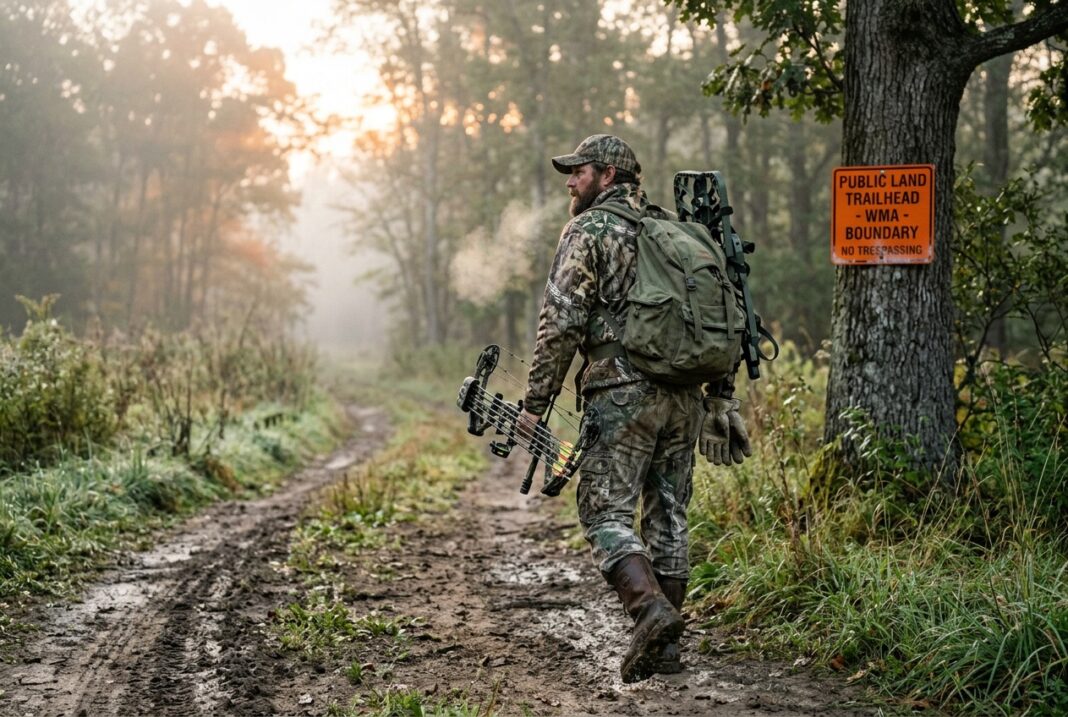
Public land isn’t one single category. It’s a patchwork of federal, state, and sometimes county-managed ground, each with its own rulebook. The big federal players are the U.S. Forest Service and the Bureau of Land Management, which together control hundreds of millions of acres, mostly concentrated in the West but with meaningful national forest holdings in places like Missouri, Arkansas, and the Appalachians.
Then you’ve got state-managed land — Wildlife Management Areas, state forests, state game lands, whatever your state calls them. These are usually purchased or set aside specifically for hunting and wildlife habitat, funded in large part by hunting license sales and excise taxes on gear through the Pittman-Robertson Act. That’s worth sitting with for a second: the ammo and broadheads you bought this year are literally funding the land you’re about to hunt.
Finally, there’s a smaller category of walk-in access programs, where states pay private landowners to open their ground to public hunting for a season. These are gold mines if you find them early, because most hunters don’t even know they exist.
How Access and Permits Actually Work
This is where people trip up. Some public land is open-access, no permit required beyond your basic hunting license. Other tracts require a separate WMA stamp, a lottery-drawn tag, or a specific area permit you have to apply for months in advance. State forests in Pennsylvania work differently than state forests in Michigan, which work differently than BLM parcels in Wyoming. There is no universal rulebook, and assuming your home state’s system applies elsewhere is how hunters end up cited or, worse, sitting in a closed unit during firearm season without realizing it.
Every serious public land hunter I know keeps a habit of checking the current regulations digest for the specific unit they’re hunting, not just the state as a whole, every single year. Rules change. A tract that allowed rifle hunting last year might be shotgun-only this year because of a nearby subdivision expansion. Boundaries get redrawn. Seasons shift by a week. If you’re not checking your state wildlife agency’s current regs before every trip, you’re gambling with a citation.
Some states also stack additional requirements on top: mandatory check-in stations, harvest reporting apps, orange vest requirements that differ between archery and firearm seasons. None of this is hard once you know it. But it’s not intuitive, and it’s not the same everywhere, which is exactly why so many public land newcomers get frustrated in year one and quit before they figure it out.
Understanding Pressure and Why Most Hunters Never Get Past the First Half-Mile
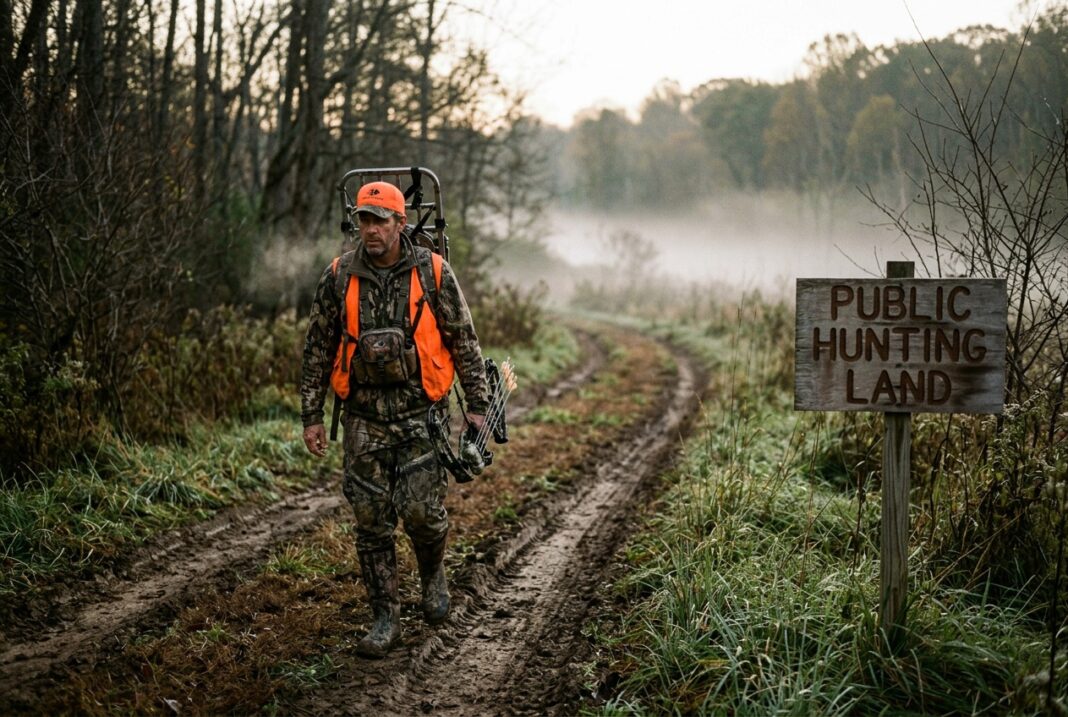
Here’s an opinion I’ll state flatly: the biggest reason public land gets a bad reputation isn’t the deer numbers, it’s hunter behavior. Most guys park at the main lot, walk the marked trail, and set up within four hundred yards of the truck. That’s not a criticism, it’s just physics — most people won’t drag a stand a mile and a half through swamp bottom before shooting light. Which means the deer learn the pattern fast, and by week two of season, that easy access ground is hunted out for daylight movement.
The National Deer Association has published research showing pressured public land deer shift almost entirely nocturnal within days of sustained hunting pressure, and shift core areas away from access points. That tracks with what any public land regular already knows in his gut. If you want daylight bucks on public ground, you have to go where the other five trucks in the lot didn’t. That usually means further, wetter, thicker, or steeper than most people are willing to go.
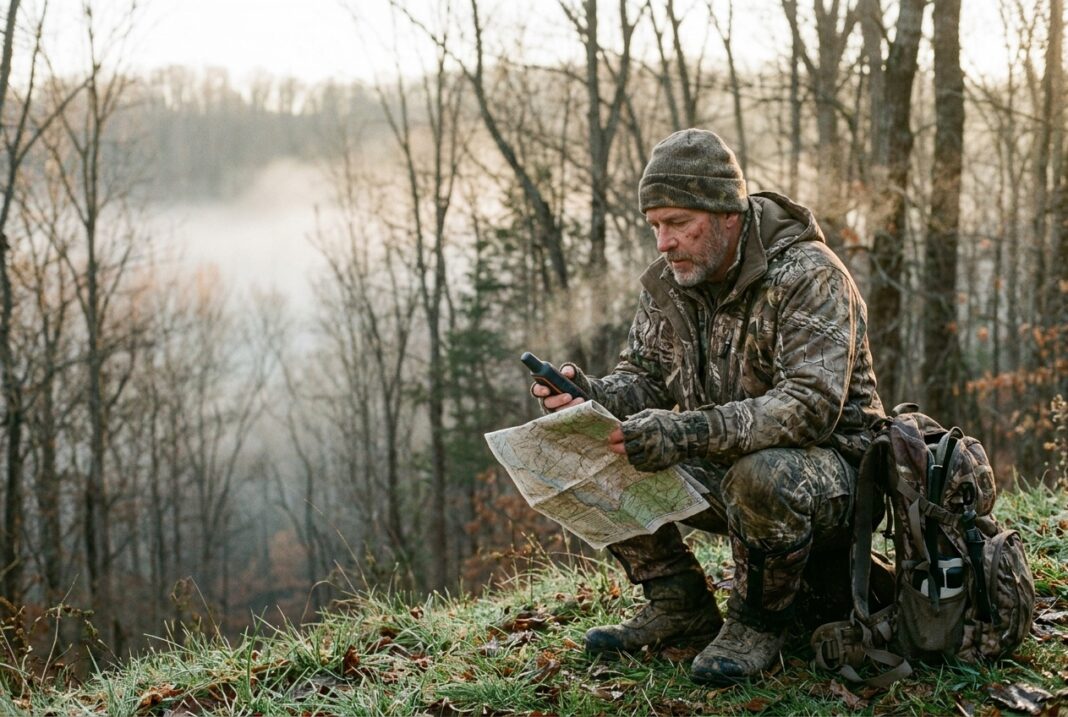
I learned this the hard way my first two seasons hunting public ground in Ohio. I hunted the same finger ridge everyone else did because it was closest to the lot and had obvious sign. I saw does. I saw yearling bucks. I never saw a mature deer in daylight, not once, in two full seasons. The third year I pulled up onGaia GPS, found a pinch point almost a mile back through standing water nobody wanted to cross, and killed my best public land buck to date on the second sit. The lesson wasn’t subtle. Distance from access is doing half the work for you before you even nock an arrow.
Stand Placement, Ethics, and the Unwritten Rules
Public land etiquette isn’t written into any regulation book, but it’s real, and violating it will get you a cold reception at best. The core rule: if another hunter’s truck or setup is already established in an area, you don’t move in on them. That means not parking next to an obviously occupied lot before daylight, not setting up a stand within sight or easy bow range of someone else’s spot, and not blowing through a drainage where you can see another hunter’s headlamp already sitting.
There’s also a quieter rule about stands themselves. Most public tracts prohibit permanent stands or require them to be removed at season’s end — screw-in steps and nailed ladder stands are illegal in a lot of jurisdictions and genuinely damage public timber. Portable setups you pack in and out are the standard, and honestly, they should be. It’s not your land. Treat it like you’re borrowing something valuable, because you are.
I’ll be blunt about something else too: scouting cameras left on public land get stolen constantly, and honestly I don’t have a ton of sympathy anymore. If you’re hanging a two-hundred-dollar camera on a public tree in a high-traffic access corridor, you’re gambling, and the odds aren’t great. Cellular cameras with locked boxes help. Common sense placement — away from trails, away from the obvious pinch points everyone glasses — helps more.
Habitat Management Is Happening Whether You Notice or Not
One thing a lot of hunters miss: public land isn’t static. State wildlife agencies actively manage these tracts through prescribed burns, timber harvests, food plot rotations, and water control structures on WMAs designed for waterfowl but loaded with deer sign in the timber edges. A clear-cut you hunted three years ago might be waist-high in browse now, holding more deer than the mature timber ever did. Conversely, a thick bedding area might get logged and pushed deer somewhere else entirely.
This matters because static thinking kills public land success. The spot that produced in 2019 might be a ghost town in 2026 because the habitat changed under it. Checking your state agency’s timber harvest schedules and prescribed burn maps, when they’re published, gives you a real edge most hunters never bother to look for. It’s not glamorous work, but neither is sitting in the wrong tree for three weekends running.
Dealing With Other Hunters Without Losing Your Mind
You will run into other people. That’s not a bug in the public land system, it’s the entire design of it. Some seasons you’ll pull into a lot and see six trucks already there for a fifteen-hundred-acre tract, and you’ll have to make a real decision about whether to hunt somewhere else, hunt an overlooked corner, or come back at midday when the morning crowd has thinned out.
The hunters who do well long-term on public ground aren’t necessarily the most skilled woodsmen. They’re the ones who’ve built a mental map of six or eight different properties instead of marrying themselves to one, so pressure on any single tract doesn’t sink their whole season. That flexibility is the real skill public land teaches you, more than any single scouting trick.
The Bottom Line on Public Ground
Public hunting land works because generations of hunters funded it, state and federal agencies manage it, and a code of conduct — some written into law, some just understood — keeps it functional for everyone using it. It rewards effort, punishes laziness, and doesn’t care how nice your gear is if you’re set up in the wrong spot. That’s frustrating for some guys. For me, it’s the whole appeal. Nobody’s handing you a mature buck on public ground. You earn every single one, and that makes them worth more than anything I’ve ever killed behind a locked gate.
— WhitetailFanatic.com