How Does Public Hunting Land Work? A Whitetail Hunter’s Real-World Guide
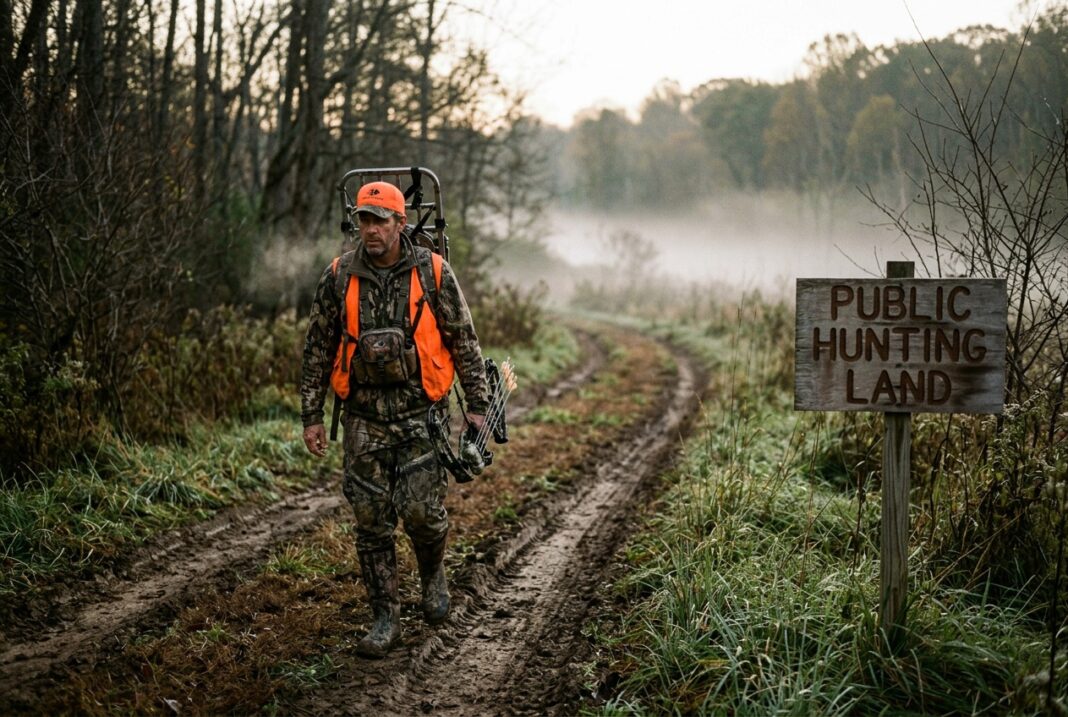
Every fall, thousands of hunters stare at a map of green polygons and wonder what they’re actually allowed to do on that ground. Public land looks simple from the outside — it’s open, it’s free (mostly), and it’s yours to hunt. But the mechanics underneath that simplicity trip up more hunters than they’d like to admit. I’ve been one of them. I once drove three hours to a Wildlife Management Area only to find out the unit I’d scouted on satellite imagery was closed to hunting during the exact week I planned to be there. That mistake cost me a vacation day and taught me more about how public land actually works than any article I’d read beforehand.
This piece is meant to fix that gap. Public hunting land isn’t one uniform system — it’s a patchwork of federal, state, and sometimes county-managed ground, each with its own rulebook. Understanding that patchwork is the difference between a productive season and a wasted one.
What Counts as “Public Hunting Land,” Exactly
Public land generally falls into a few buckets: national forests, Bureau of Land Management acreage, state Wildlife Management Areas (WMAs), state forests, and in some cases, walk-in access programs on private ground enrolled through state incentive programs. They are not interchangeable. National forest land, managed by the U.S. Forest Service, typically allows hunting under state regulations without a separate permit, though specific closures do exist around campgrounds, trailheads, and administrative zones. BLM land works similarly — vast, multi-use, and governed by state hunting law layered on top of federal land-use rules, which you can check directly through the BLM’s hunting resource pages.
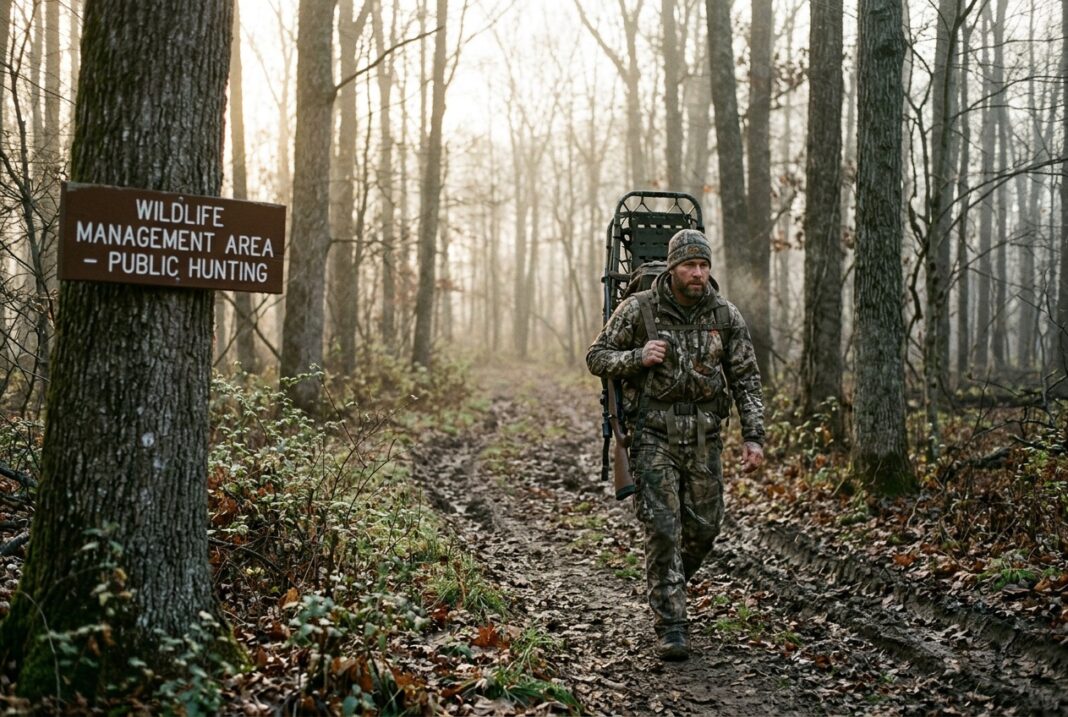
State WMAs are a different animal entirely. These are parcels purchased or leased specifically for wildlife management and public recreation, and they almost always come with their own set of rules layered on top of statewide regulations — sign-in stations, quota permits, weapon restrictions, or dates that don’t match the general season. Treat every WMA as its own rulebook. Don’t assume consistency just because two properties sit twenty miles apart in the same state.
Access Rules Aren’t Optional Suggestions
The biggest misconception new public land hunters carry is that “public” means “unrestricted.” It doesn’t. Most states require hunters to check a specific regulations guide for the individual property, not just the statewide digest. Some WMAs cap the number of hunters allowed per day through a draw or sign-in system. Others prohibit tree stands with screw-in steps, ban baiting outright, or restrict vehicle access to designated roads only.
I’ve watched a guy get his gear confiscated at a check station in Missouri because he didn’t realize the area required non-toxic shot for waterfowl blinds bordering the deer unit he was hunting. He wasn’t cheating. He just didn’t read the fine print. That’s the lesson: the fine print is the actual rulebook, and the statewide hunting digest is just the starting point.
Before you ever step foot on a property, pull the specific area regulations from your state’s Department of Natural Resources or Fish and Wildlife agency website. The U.S. Fish and Wildlife Service’s refuge hunting portal is a good example of how granular these rules can get — individual refuges post PDF maps showing exactly which zones are open, which are archery-only, and which are closed entirely to protect nesting or wintering wildlife.
Seasons Overlap, and That Changes Everything
Public land often hosts multiple hunting seasons stacked on top of each other. Archery deer season might overlap with small game season, turkey season in some southern states, or even waterfowl season if the property borders wetlands. That means you’re not just competing with other deer hunters — you’re sharing ground with rabbit hunters, squirrel hunters, and sometimes upland bird hunters walking through with dogs.
This changes your strategy. A stand location that seems perfectly quiet in September archery season might get walked through constantly once small game season opens in October. I’ve had mornings ruined by a beagle pack working a rabbit trail fifty yards from my stand. Nobody did anything wrong. That’s just public land — it’s shared, and shared means unpredictable.
Smart public land hunters build in redundancy. Have three or four spots scouted, not one. If your primary honey-hole gets pressured by other user groups, you need a backup that isn’t compromised.
Pressure Is the Real Predator on Public Ground
Here’s the blunt truth: on most public land, human pressure — not predators, not habitat — is the single biggest factor pushing deer behavior. Mature bucks on heavily hunted public ground shift to nocturnal patterns faster and harder than bucks on private land with controlled access. Research from the National Deer Association has consistently shown that hunting pressure alters deer movement timing more than almost any other variable short of the rut itself.
If you’re hunting a WMA that gets slammed with orange every opening weekend, don’t expect daylight movement from a mature buck in the first thirty minutes of legal light near a parking area. He’s already patterned that pressure. He knows where the trucks park and where the boots walk. Your job is to find the terrain features — a bench nobody wants to climb to, a swamp edge nobody wants to wade through — where that pressure doesn’t reach.
Permits, Quotas, and the Draw System
Some of the best public deer hunting in the country runs on a limited-quota draw system. Certain WMAs, especially those managing for trophy potential or controlling herd density, require hunters to apply months in advance for a limited number of tags or access days. Miss the application window, and you’re locked out for the year regardless of how badly you want in.
This system exists for a reason — it protects the resource and the hunting experience from being overrun. But it also means public land hunting requires calendar discipline most hunters don’t build into their planning. Mark application deadlines the way you’d mark the rut. If a state’s draw system opens in May and closes in June, that’s non-negotiable. There’s no late entry.
Check your state wildlife agency’s website directly rather than relying on hunting forums for these dates — regulations and deadlines shift year to year, and forum posts age badly. A five-minute check against the official source saves you from finding out in October that you needed to apply in April.
Scouting Public Land Requires a Different Mindset
Private land scouting often means walking property freely, hanging cameras wherever you want, and building a season-long relationship with a small piece of ground. Public land scouting works differently, and pretending otherwise is where a lot of hunters go wrong.
First, camera theft is real on public ground. Locking cables and hidden placement aren’t paranoia — they’re standard practice. Second, over-scouting a public parcel in the weeks before season can burn it out before you ever hunt it. Every trip in leaves boot scent, and mature bucks on pressured ground react to human intrusion patterns the same way they react to hunting pressure itself.
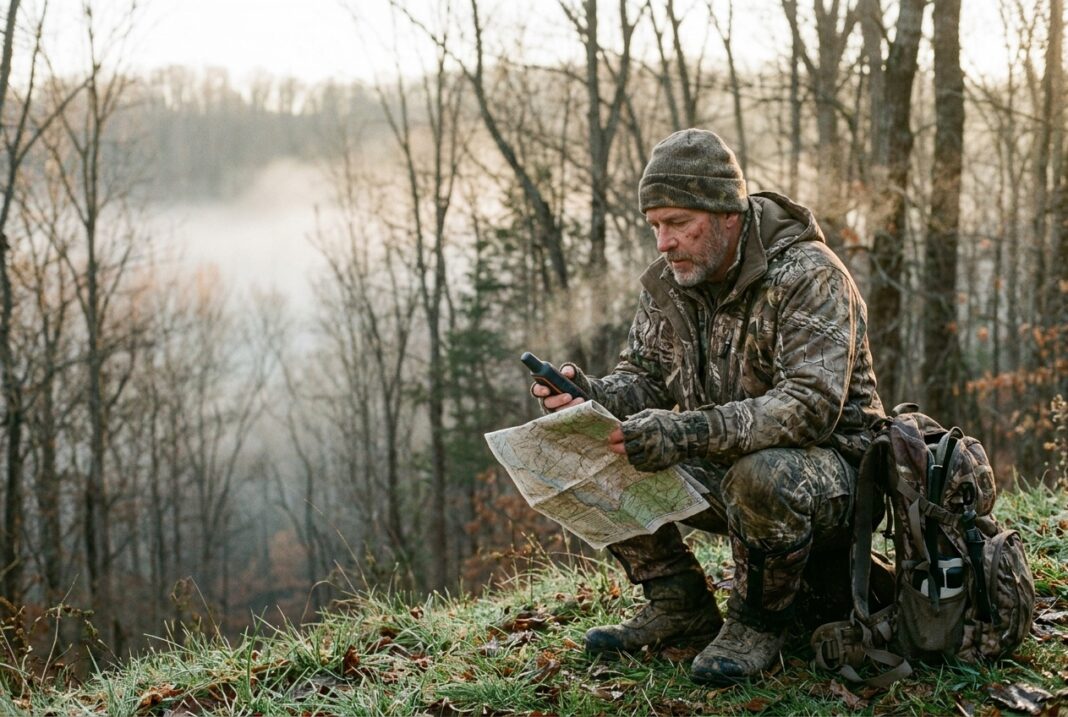
I learned this the hard way on a state forest tract in the Midwest. I scouted it four times in September, checking cameras, second-guessing stand locations, walking the same trails. By the time archery season opened, the deer had already relocated their core bedding fifteen minutes away. My presence had done exactly what pressure does — pushed them out before I ever drew back a bow. Now I scout once, hard and efficient, using satellite maps and topo lines to do 80 percent of the work before boots ever touch the ground.
Etiquette Matters More Than Most Hunters Admit
Public land hunting runs on an unwritten code, and breaking it creates real friction between hunters sharing the same ground. Don’t set up within sight or sound of another hunter’s stand. Don’t move in on a spot where you can see a truck already parked at the trailhead closest to it. If you find someone’s stand or blind, that spot is spoken for regardless of whether they’re in it that morning.
This isn’t law — it’s courtesy, and public land hunting communities are small enough that reputations follow you. I’ve seen guys burn relationships with entire hunting clubs over parking-lot arguments that started because someone walked in on a spot they didn’t realize was already claimed. Ask around. Read the lot. Give people room.
The Bottom Line on Public Land
Public hunting land works because it’s built on a layered system: federal or state ownership, statewide hunting law, property-specific regulations, and — often overlooked — the informal culture built by the hunters who use it every season. None of those layers are optional, and ignoring any one of them is how good hunters end up with citations, burned spots, or wasted trips.
The upside is real, though. Public ground offers access most private landowners will never extend to a stranger, and some of the best bucks I’ve ever hunted came off ground anyone could have walked onto. You just have to respect the system enough to learn how it actually works before you expect it to produce for you.
—