How Does Public Hunting Land Work? A Whitetail Guide
Every fall, a fresh wave of hunters discovers that the woods they’ve been driving past for years — the ones with the brown gate and the faded sign — are actually open to them. No lease payment, no handshake deal with a farmer, no waiting for an invite. Just boots, a license, and a little homework. That’s the promise of public hunting land, and it’s real. But the mechanics behind it trip up a lot of people who assume “public” means “simple.”
It isn’t always simple. Public land hunting operates under a patchwork of federal, state, and sometimes county rules that vary depending on who manages the ground beneath your boots. Understanding that patchwork is the difference between filling a tag on properties nobody else is willing to work for, and getting a citation — or worse, walking into a spot that’s closed for a controlled hunt draw you never knew existed.
This is the honest breakdown of how public land actually works, written for hunters who are serious about using it well.
What “Public Land” Actually Means
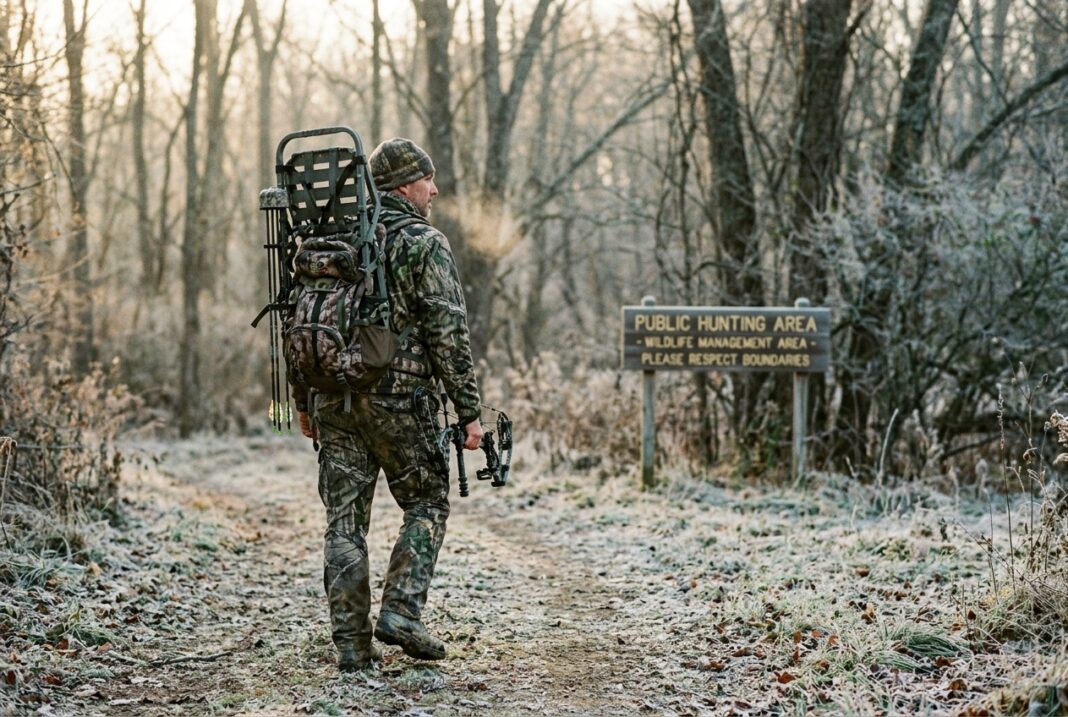
Public land isn’t one thing. It’s a category that includes several very different ownership structures, each with its own rulebook. State Wildlife Management Areas (WMAs) are managed by your state’s fish and wildlife agency and funded largely through license sales and excise taxes on gear. National forests fall under the U.S. Forest Service, which generally allows hunting under state regulations but layers on its own rules about camping, motorized access, and road closures. Bureau of Land Management ground, concentrated heavily in the West but present in pockets elsewhere, follows a similar model. National Wildlife Refuges are different again — many allow hunting, but only in designated units and often with additional permits, managed under guidelines from the U.S. Fish and Wildlife Service.
Then there are state-specific access programs — Walk-In Areas, Voluntary Public Access land, block management in some western states — where private landowners open their ground to public hunting in exchange for compensation or tax incentives. That land is privately owned but publicly accessible, which is a distinction that matters when you’re trying to figure out what’s legal there and what isn’t.
The blunt truth: if you assume all public land plays by the same rules, you’re going to get burned eventually.
How Access and Permits Actually Work
Most state WMAs require nothing more than a valid hunting license and, in many states, a habitat stamp or land access permit that costs a few extra dollars. Some states require you to check in and check out at a kiosk, either on paper or through an app. National forest land typically requires just your state license, since the Forest Service defers hunting regulation to the state wildlife agency — but you’ll still need to respect Forest Service rules on things like camping duration, ATV use, and fire restrictions.
Where it gets more complicated is controlled-access land — refuges, certain WMAs, and high-demand units on BLM or Forest Service ground — where you might need to enter a draw, apply for a specific tag, or reserve a hunting date months in advance. Some refuges only open for a handful of hunt days a year. Miss the application window, and you’re out until next season, no exceptions.
My advice, stated plainly: read the regulations for the specific property, not just the state hunting digest. I’ve watched hunters get turned around by a conservation officer because they assumed statewide rules covered a refuge unit with its own separate hunt plan. The digest is the floor. The property-specific rules are what actually govern you standing there.
Finding the Right Piece of Ground
Every state wildlife agency publishes interactive maps of WMAs, wildlife areas, and public hunting land — usually free, sometimes buried three menus deep on the agency website. It’s worth the digging. Combine that with GPS mapping apps like onX or HuntStand, which overlay public land boundaries, ownership lines, and in many cases access points, and you can scout from your couch before you ever burn boot leather.
Don’t stop at boundary lines. Look at topography, water sources, and timber age. Public land that’s easy to reach on foot from a parking lot gets hammered — that’s just how it goes. The ground that rewards you is usually the ground that requires an extra half-mile walk, a creek crossing, or a nasty little ridge nobody wants to drag a deer up. That’s not a secret. It’s just a filter most hunters don’t bother running themselves through.
Hunting Pressure: The Real Cost of “Free” Land
Here’s the part nobody puts on a brochure: public land access is free, but it’s not without cost. The cost is pressure. Deer on heavily hunted public ground pattern human activity as fast as they pattern acorn drops, and they adjust — shifting nocturnal, tucking into thicker cover, avoiding anything within earshot of a road.
The National Deer Association has published research showing how quickly whitetails alter movement in response to hunting pressure, sometimes within days of season opening. That’s not abstract data for public land hunters — it’s the reason the guy who hunts opening morning at 6 a.m. shoots a buck that the guy sleeping in and walking the same trail at 9 a.m. never sees. Pressure compounds. Every truck in the lot, every trail camera flash, every hunter who rattles too aggressively too early — it all pushes deer toward the property lines and the nastiest cover available.
If you’re serious about consistently killing mature bucks on public ground, you have to hunt like pressure is the primary predator you’re working around, not an afterthought.
A Lesson I Learned the Hard Way
I’ll be honest about a mistake, because it’s the kind of thing that separates public land hunters who improve from the ones who quit and go buy a lease. My second season hunting a state forest, I found a incredible pinch point between a swamp and a ridge — the kind of spot that looks too good to be true on a map. I hunted it four times in three weeks. Never saw a deer during shooting light. I assumed the spot was overrated.
It wasn’t overrated. I was the problem. I parked in the same visible pull-off every time, walked the same trail at the same time, and never once considered that other hunters — or the deer themselves — had me completely patterned within a week. A buddy who actually killed a good buck fifty yards from that same pinch point told me flatly: “You’re advertising yourself.” He was right. I switched entry routes, started parking a half-mile away and walking in through timber instead of along the obvious trail, and by the next season I was seeing shooter bucks in daylight in that exact spot. The land didn’t change. My discipline did.
That’s the lesson public land forces on you eventually: it’s not just about finding good ground, it’s about hunting it like someone else already knows about it too — because they probably do.
Etiquette That Keeps Public Land Open
Public land access is a privilege funded by license dollars, excise taxes, and, in a lot of cases, active habitat management by state biologists. It’s not guaranteed forever. Overcrowding, conflict between user groups, and bad behavior — leaving stands up illegally, disputing spots with other hunters, ignoring closures — all put pressure on agencies to tighten access or restrict it further.
A few rules I consider non-negotiable: never set up within sight or easy earshot of another hunter’s stand, respect posted closures even if you think they’re overly cautious, pack out everything you bring in including tree steps and climbing sticks, and don’t burn a spot by blasting it on social media the week before season. Public land works because enough hunters treat it with the same respect they’d want shown to their own back forty. Break that, and everyone loses access a little faster.
Making Public Land Work For You
Public hunting land isn’t a lesser version of a private lease — it’s a different game with its own skill set. Success on public ground rewards scouting discipline, willingness to walk farther than the next guy, and a real understanding of how pressure moves deer. It punishes laziness and shortcuts fast.
Start with your state agency’s official hunting regulations and public land maps — they’re the ground truth for what’s legal where you plan to hunt. Layer in national forest or BLM rules if that’s the ground you’re working. Then go scout it yourself, on foot, before you ever hang a stand. Public land will teach you more about deer behavior under pressure than any private lease ever will, mostly because it doesn’t give you any shortcuts. That’s exactly why it’s worth learning to hunt well.
—